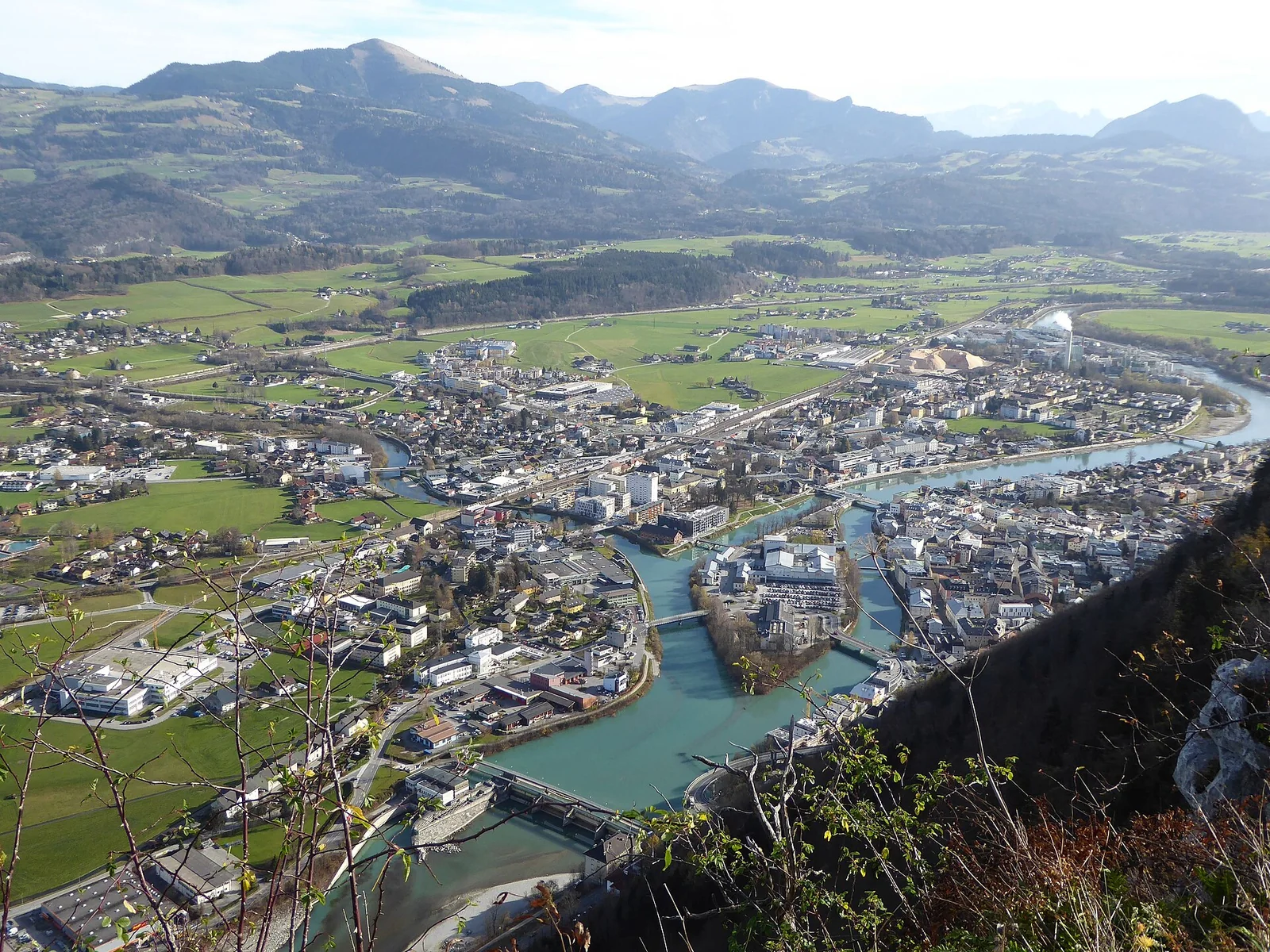
The city that explains Salzburg
After the representative Salzburg, Hallein introduces the economic base of the region. The city's official history links the development of salt mining and brine boiling with the income of the princely archbishops. It is worth seeing both places as a pair: one associated with the production of wealth, the other with its manifestation in architecture. This perspective enriches even a short stop, without having to visit all the exhibitions.
The urban landscape is not exclusively medieval. Changes in the development of salt works also influenced the shape of today's squares. When looking around the centre, look for the relationship between work space, retail and housing. This is a more interesting topic than looking for one facade that would summarise the entire history of Hallein.
The Old Town in a few short passages
The local tourism organisation indicates Schöndorferplatz, Bayrhamerplatz, Kornsteinplatz and Bruckhäuserplatz as the centre's characteristic spaces. The city's development was limited by the Salzach and the slopes of Dürrnberg. In practice, this means the ability to view a compact structure of streets and squares, instead of distant monuments scattered throughout a vast agglomeration.
We suggest a short walk taking in two selected squares, a street connecting them and a return towards the river. You do not need to find a perfect loop: when passing through by bike, it is often simpler to walk out and back to the same point. Narrow passages are best explored on foot. Follow local signs in pedestrian areas; wheeling your bike makes it easier to notice the details.
What does the Keltenmuseum bring?
The Celtic Museum shows finds from Dürrnberg and the history of the salt community. Its topic is not limited to the method of digging: it covers settlement life, burials and objects indicating trade contacts. If you are interested in how a raw material can change the meaning of a small area, this is a better place than another photo from a viewpoint.
If you have limited time, choose one theme of the exhibition: work, everyday life or exchange. When looking at tools and personal items, compare their function, not the number of display cases. A trip to the museum requires your own time and checking the hours for a specific day. Don't assume that a short bicycle stop will be enough to leisurely walk through the entire exhibition.
The history also goes back to the 20th century
Salt production in Hallein ended in 1989. This is a useful date for reading the city: salt is not just a distant story about the Celts and the Middle Ages, but part of a relatively recent industrial history. You may ask what becomes a museum, public square or other urban space after production is completed.
This observation will be useful later on Alpe Adria, where the infrastructure of former transport functions is also changing the way it is used. This does not mean that all the objects you pass are monuments or that you can enter them. In Hallein, it is worth sticking to the available public spaces and documented exhibitions, rather than looking for an entrance to every former industrial building.
A short, museum or all-day stop
The short variant is your own suggestion of 25-40 minutes for the centre and a drink. The museum variant requires a wider window, which should be determined after checking the current offer of the Keltenmuseum. The full-day option connects the city with Dürrnberg and should take place before the main trip or require its extension.
The most common mistake in the plan is to add each attraction separately as a small extra. The museum, meal, mine and old town together form a complete programme. In the four-day version, we would leave Hallein primarily as a short cultural stop. On the five-day itinerary, you can extend your visit, but remember that the first overnight stay is only in Dorfgastein.
Where to look for a break to eat
The squares of the centre are a logical area to look for a café or a meal if you want to see the old town anyway. Instead of choosing a place based solely on photos, check whether it serves meals or only drinks and baked goods during your visit. This is especially important if you plan to take a longer break in Hallein before continuing south.
For four people, it is easier to compare the entire cost of a stay: getting to the premises, waiting for a table, ordering and returning. If a group wants to visit a museum, eating before entering allows for a more leisurely tour. If the goal is only to relax, there is no need to turn it into a mandatory extensive culinary visit.
When an overnight stay in Hallein changes the plan
An overnight stay in Hallein may be reasonable with an extra day devoted to salt history. However, it is not a simple matter of replacing Salzburg in the described plan without consequences: you need to determine where the car stays and where the calculated distance actually starts from. Such a shift also affects the return to the car after the end of the trip.
When choosing an address, pay attention to whether the facility is located in the city itself or higher on Dürrnberg. A common name for a tourist region does not mean an identical location. People who want to walk around the Old Town after dinner are more suited to staying overnight in the centre; For those interested primarily in the mine, another location may suit them, but this is an additional option.
Hallein and Dürrnberg: one background, two programmes
The Keltenmuseum and the mine complement each other, but do not replace each other. The museum helps interpret the finds and the lives of former inhabitants; the mine offers an experience of the underground space in the form of an organised tour. If you have time for one attraction, the choice should be based on your interests and not on the assumption that both take a similarly short time.
On the leg to Gastein, choose Hallein as a more time-limited stop. Plan a trip to Dürrnberg separately: it requires much more time than a short walk around Hallein. This distinction protects the most valuable part of the first day: the ability to get to your accommodation without rushing.
Sources and currency
- Hallein - the historic old town ↗Checked: 2026-11-24
- Hallein - the history of salt ↗Checked: 2026-11-24
- Salzburg Museum - The Celts ↗Checked: 2026-11-24
Organizational tips, selection of stops and scenarios are editorial suggestions. Times and budgets are not an offer or reservation. Check the opening of attractions, announcements and transport conditions for a specific date. Additional trips are not automatically part of the GPX.