How to recognise the station after the trains depart
The climb to the former station building has something different than the stop at the new premises. The architecture was created for waiting, check-in and railway traffic, and today it serves cyclists. Look at the roof, the orientation of the building in relation to the former track and the open space in front of it. These elements show the former function better than the name plate itself.
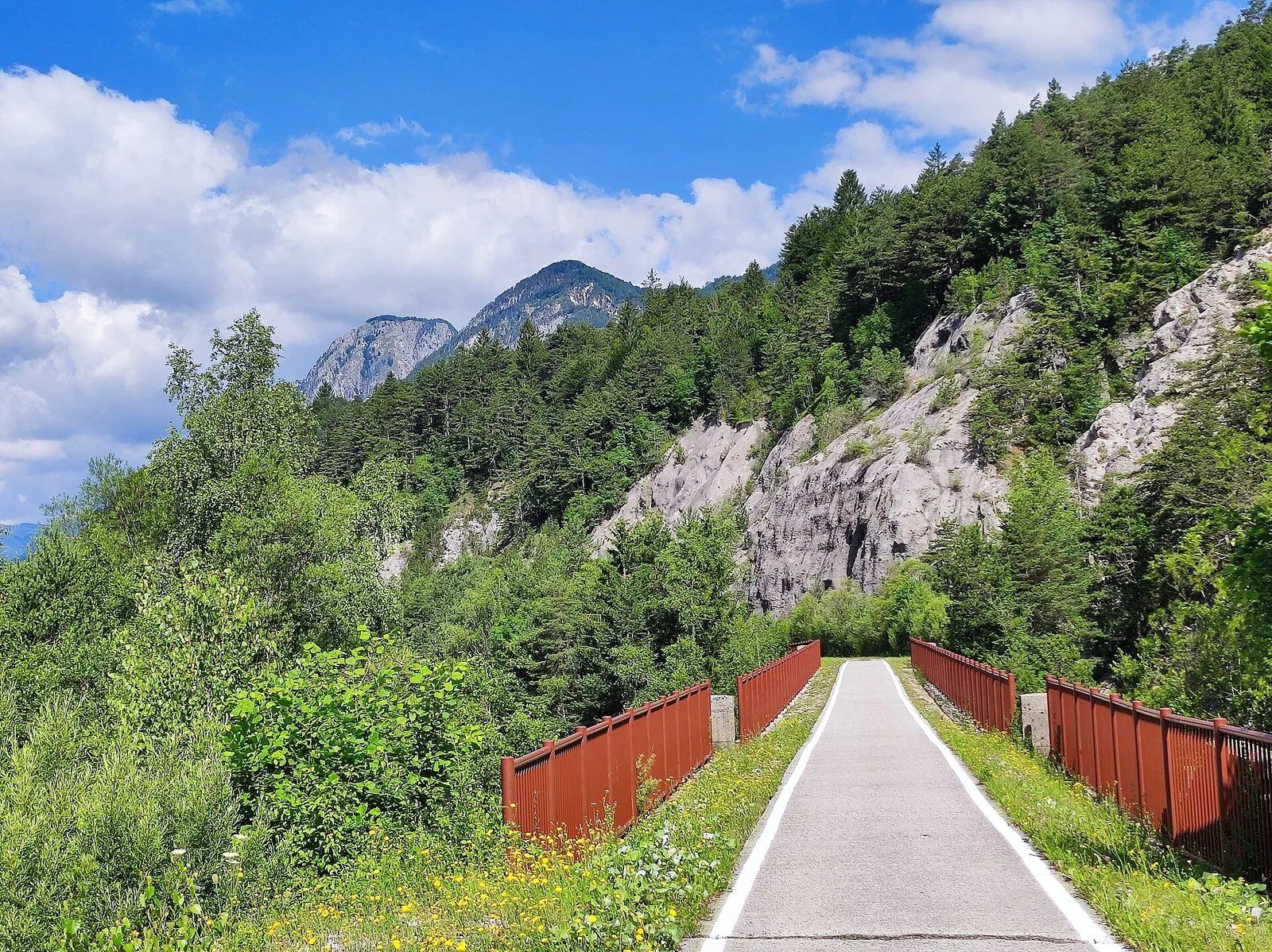
The station is a particularly good place to talk about what's left on the route. When you start moving again, you will more easily notice the smooth geometry, bridge structures and continuity of the route. Chiusaforte is not a random food court set next to a nice view, but part of the history of the entire corridor.
Services in the former station
The official website of Stazione di Chiusaforte describes a seasonal rest area with a bar, food, rooms, a small library and bicycle services. It also provides information about photos of the former railway and the botanical garden. This is confirmation of the type of place; This is not a guarantee that the kitchen will be open, there will be free accommodation or the possibility of carrying out a specific repair during your trip.
If the station is to be the main meal of the day, check the operator's current information. Menus and services may vary. You don't have to plan everything for an ad hoc break, but it's not worth making the entire group dependent on an unconfirmed single point. Keep the alternative of eating from your own supplies and stopping somewhere else.
Compare the old and today's view
If historical photographs are available, choose one showing a building or track and try to find the same direction of view. Comparison is a simple way to see the scale of change: what disappeared, what remained, what began to serve different needs.
You don't have to reconstruct the frame perfectly. It might be more interesting to write down three differences and one constant. For people who are not interested in railway technology, such a small observation often opens the topic better than a long list of opening dates of individual sections.
Chiusaforte was important before the creation of Ciclovia
The regional history description indicates the development in the Roman and Venetian periods and the former defensive function of the narrowing of the valley. Later conflicts changed the importance of the fortifications. There are also preserved examples of local residential architecture in the surroundings, reminding us that the life of the town was not limited to transport.
During the walk, compare the public facility, which was the station, with the houses of the town. They differ in scale, purpose and relationship to the street. This helps avoid the impression that the settlements you pass exist mainly to provide cyclists with coffee. They are living places of which new tourism is one of many chapters.
A stop at the station or a walk around Chiusaforte
Choose a time according to your goal. If you just want to rest, twenty minutes can be a full-fledged break. If you want to explore the place, separate your meal from your walk and do not try to explore the entire area from the saddle.
| Time | Programme |
|---|---|
| 20 minutes | The station from the outside, a short break and a look at the former tracks. |
| 60 minutes | The station, historical materials if available, and a meal depending on the service offered. |
| 120 minutes | A quiet walk around the town and one longer stop at the station. |
Val Raccolana is not a shortcut to the next point
Chiusaforte lies at the entrance to another alpine valley. Raccolana and Sella Nevea appear in tourist materials, but they are not part of the basic route to Venzone. Side directions take you into a different landscape and can be a serious uphill climb.
When looking at the map, distinguish the goals of the town from the goals of the entire commune. Not every entry on the tourist list means an attraction available within a five-minute walk from the station. If you want to explore the mountains, plan a separate day; during Alpe Adria, it is enough to consciously see the place where the main valley joins the side valley.
Further travel: the station does not end the history of the railway
After Chiusaforte, it is still worth observing the traces of the former Pontebbana. The subsequent structures create a continuous story about how the line is routed through tight terrain. Don't make each bridge a separate stop; a few well-watched examples say more than a series of braking without a safe place.
Before setting off, decide whether the next thematic point is Resiutta or Venzone. Chiusaforte can be the main break of the day. In this arrangement, further travel becomes a leisurely observation of the landscape, rather than a pursuit of the next must-see points.
Sources and currency
- Stazione di Chiusaforte - official website of the operator ↗Checked: 2026-11-24
- PromoTurismoFVG - Chiusaforte ↗Checked: 2026-11-24
Organizational tips, selection of stops and scenarios are editorial suggestions. Times and budgets are not an offer or reservation. Check the opening of attractions, announcements and transport conditions for a specific date. Additional trips are not automatically part of the GPX.