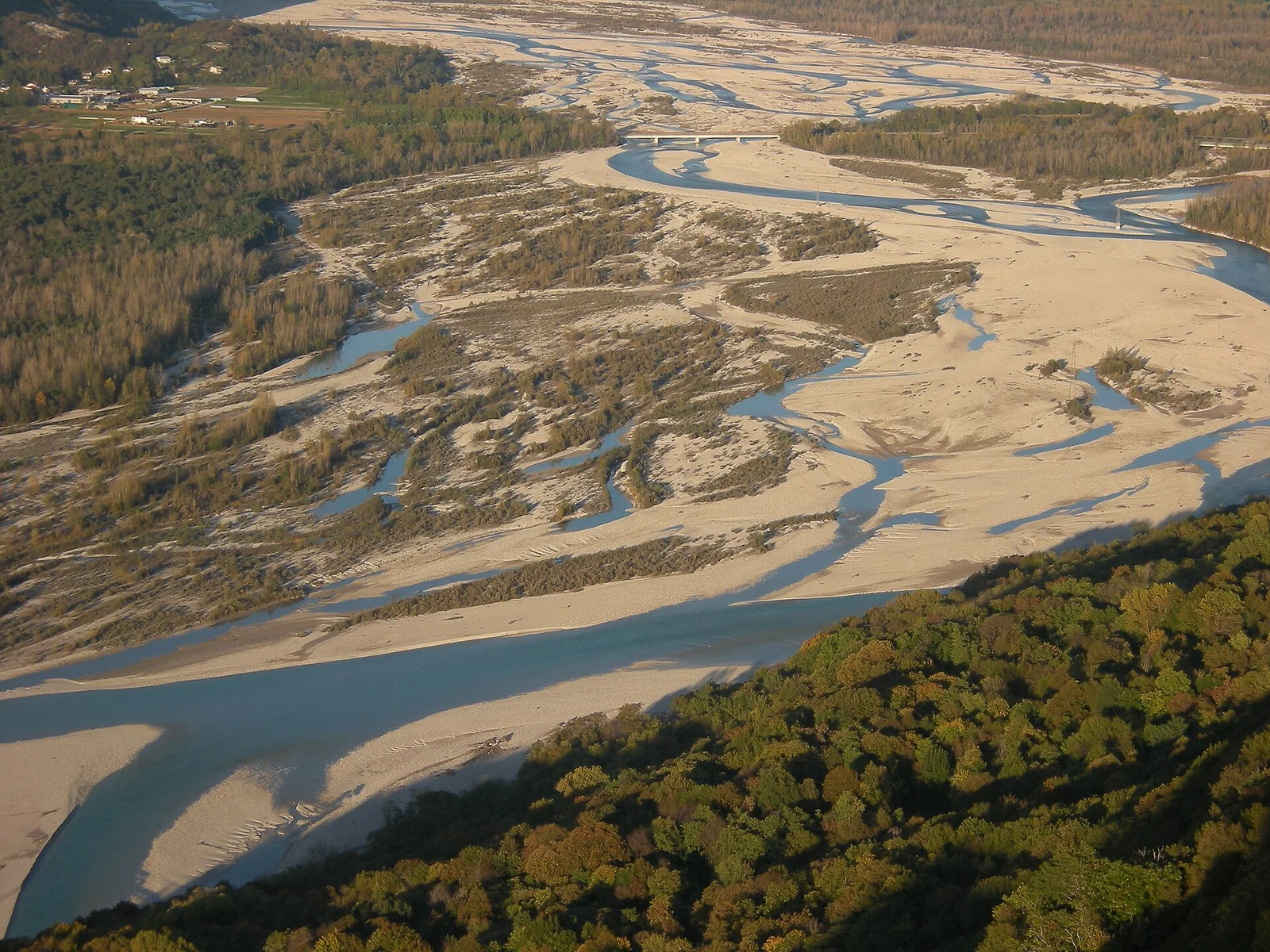
A braided river
Tagliamento is one of the most important European examples of a river with an extensive system of braided channels. In this arrangement, the stream splits and reconnects between the sediment bars. The wide strip of light gravel is therefore not an empty place next to the river proper: it is a space in which the river works at various water levels. During low flow, only some arms are active.
Regional studies indicate the gorge near Pinzano as an important boundary between the mountain and plain areas. The slope, valley width and material transport conditions continue to change. The river does not have one unchanging cross-section characteristic of the entire course.
Sediment is part of the flow
Water transports not only what remains invisible within its volume, but also grains of sand and gravel that move along the bottom. As flow conditions change, some material is deposited and other portions of the bottom are washed away. The formation of a sandbar changes the distribution of the current; a new stream may later cross the same sandbank.
Research on the historical evolution of Tagliamento uses ancient maps, documents and hydrological data. They show that the contemporary view is one moment of a longer process. Comparing photographs taken in different years only makes sense after taking into account the water level: a change in the visible gravel surface does not necessarily mean a change in the bed itself.
How to read a panorama
It is worth separating three elements: active arms with water, fresh sandbanks without dense vegetation and more stabilized islands. Their boundaries help you see the different running times of processes. The tree-covered shore and freshly moved gravel are part of the same system, but they react at different rates.
Viewing from a bridge or accessible point above the valley shows the layout better than a single photo above the water. Entering the dry gravel pit is not necessary to understand the landscape. A channel that is dry at the time of observation may again carry water; view analysis is not an assessment of the safety of crossing the river.
Sources and further reading
- Regione FVG: Magredi restored, the gravel bed of the Tagliamento ↗Checked: 2026-11-25
- Spaliviero: historical evolution of Tagliamento, abstract of the work ↗Checked: 2026-11-25
The thematic description does not mean that all places mentioned are on the basic GPX. Check the availability of attractions and services for the date of your visit.