The city deserves a plan other than transit
Udine is a major urban stop on the final stage, but you do not need to explore it exhaustively to see something worthwhile. The clearest short itinerary links two squares with different characters. This keeps the city from becoming merely a place to buy a sandwich or another lengthy detour with no clear endpoint.
In four days, remember about 114 km of the entire final; in five about 87 km from Buja. Both plans later go through Palmanova and Aquileia. Udine may be the main cultural visit of the day, but then the other places should be visited for a shorter time or postponed to an additional stay by the sea.
Piazza Libertà: the city's stone scene
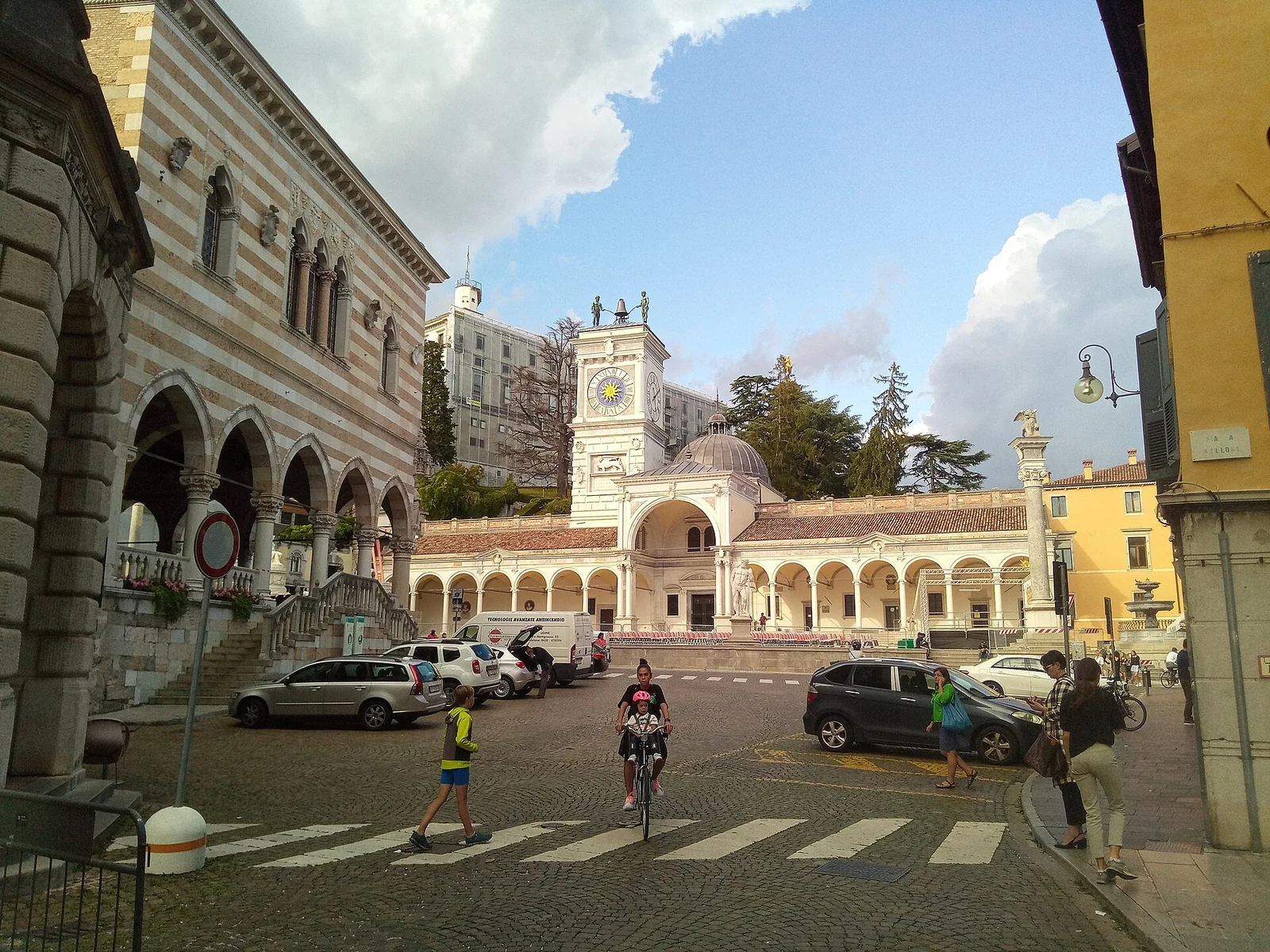
Piazza Libertà is a grand public space at the foot of the castle hill. The Loggia del Lionello, built in the mid-fifteenth century, is distinguished by alternating bands of pale and pink stone, arcades and Gothic forms. Across the square stands the San Giovanni complex with its clock tower, also marked on the official city map.
At first glance, take in the entire square: the buildings do not create an ordinary market square wall, but a composition of various levels and dominants. Then choose a loggia and see the difference between the appearance from a distance and the rhythm of the arcades up close. It's a good short programme even with museums closed.
Piazza Matteotti: a different pace in the same visit
Piazza Matteotti offers a more everyday perspective than the representative Piazza Libertà. The regional portal describes it as a place for meetings and relaxation over coffee. The combination of these two squares allows you to see both the monumental and everyday faces of the city.
Don't treat the passage between them only as a way to the next attraction. Look at the narrow streets, shop windows, arcades and places where another view opens. In a city, it is a short sequence of spaces that can be the most interesting. With heavy pedestrian traffic, riding a bike will be more convenient than trying to keep up the pace.
Castle Hill: the city viewed from above
The castle was the seat of the Patriarchs of Aquileia, later of the Venetian governor; it received a museum function in 1906. The current complex houses various collections, so the word "castle" does not describe one short interior to visit. The very approach to the hill and viewing the panorama also requires separate time.
Choose between the view and the museum if your stop is short. While viewing the city from above, try to find the places you just passed through. This change of perspective brings order to Udine's layout. If you are choosing collections, check the currently available parts and exhibitions, instead of assuming full availability of all rooms.
Tiepolo: painting created for a specific architecture
The Museo Diocesano e Gallerie del Tiepolo in the patriarchal palace presents frescoes that Tiepolo made for Dionysio Dolfin. The decorated spaces include a representative staircase, a guest gallery and the Rossa Hall. It's a different kind of art viewing than a museum with paintings relegated to neutral rooms.
Notice the viewer's position, the light, and how the painting uses real architecture. You don't have to recognise all the biblical characters to notice the illusion of space and the way the gaze is guided. If this topic interests you, dedicate the main part of your visit to it, rather than trying to combine the palace, castle and Casa Cavazzini into one short window.
Casa Cavazzini: art and a house with many layers
Casa Cavazzini houses the city's museum of modern and contemporary art. The official description highlights not only the collections, but also the building itself: a former apartment, historical decorations and archaeological discoveries, including remains older than today's buildings. This is an interesting choice if you want to change the subject after days of looking at churches.
The visit may be based on two questions: how a modern museum works in a former house and how the art of different periods meets the history of the place. The arrangement of the collection and the availability of specific works may change. Before purchasing a ticket, check the operator's current programme.
20, 60 or 120 minutes in Udine
These variants apply to staying in the centre. They are not a measured walking route and do not include access from a specific point on the trail. Two hours is a reasonable visit, but it will not be enough to thoroughly see all the city's collections.
| Time | Proposed programme |
|---|---|
| 20 minutes | Piazza Libertà and one carefully observed architectural ensemble. |
| 60 minutes | Piazza Libertà, walk towards Piazza Matteotti and a short break. |
| 120 minutes | Two squares and the hill, or one museum of your choice; adjust the scope to admission times. |
Udine at the table
The city is a good place to eat, but the word "osteria" itself says nothing about the pace of service, portion sizes or the availability of regional dishes on a given day. With limited time, choose one need: a full lunch or a short stop with coffee. A tasting menu and an extensive museum visit create a programme much longer than a regular cycling break.
If you want to try Friuli cuisine, see the separate chapter about frico and cjarsons. In Udine, the most important thing is the choice of proportion: architecture, art and food do not have to have equal share. The best short visit has one clear theme and allows you to leave with a sense of knowing the place rather than hastily checking off a list.
Sources and currency
- PromoTurismoFVG - Udine ↗Checked: 2026-11-24
- Italia.it - Piazza Libertà ↗Checked: 2026-11-24
- PromoTurismoFVG - Udine 2026 map ↗Checked: 2026-11-24
- Civici Musei Udine - Castle ↗Checked: 2026-11-24
- Civici Musei Udine - Casa Cavazzini ↗Checked: 2026-11-24
- Museo Diocesano - Tiepolo ↗Checked: 2026-11-24
Organizational tips, selection of stops and scenarios are editorial suggestions. Times and budgets are not an offer or reservation. Check the opening of attractions, announcements and transport conditions for a specific date. Additional trips are not automatically part of the GPX.