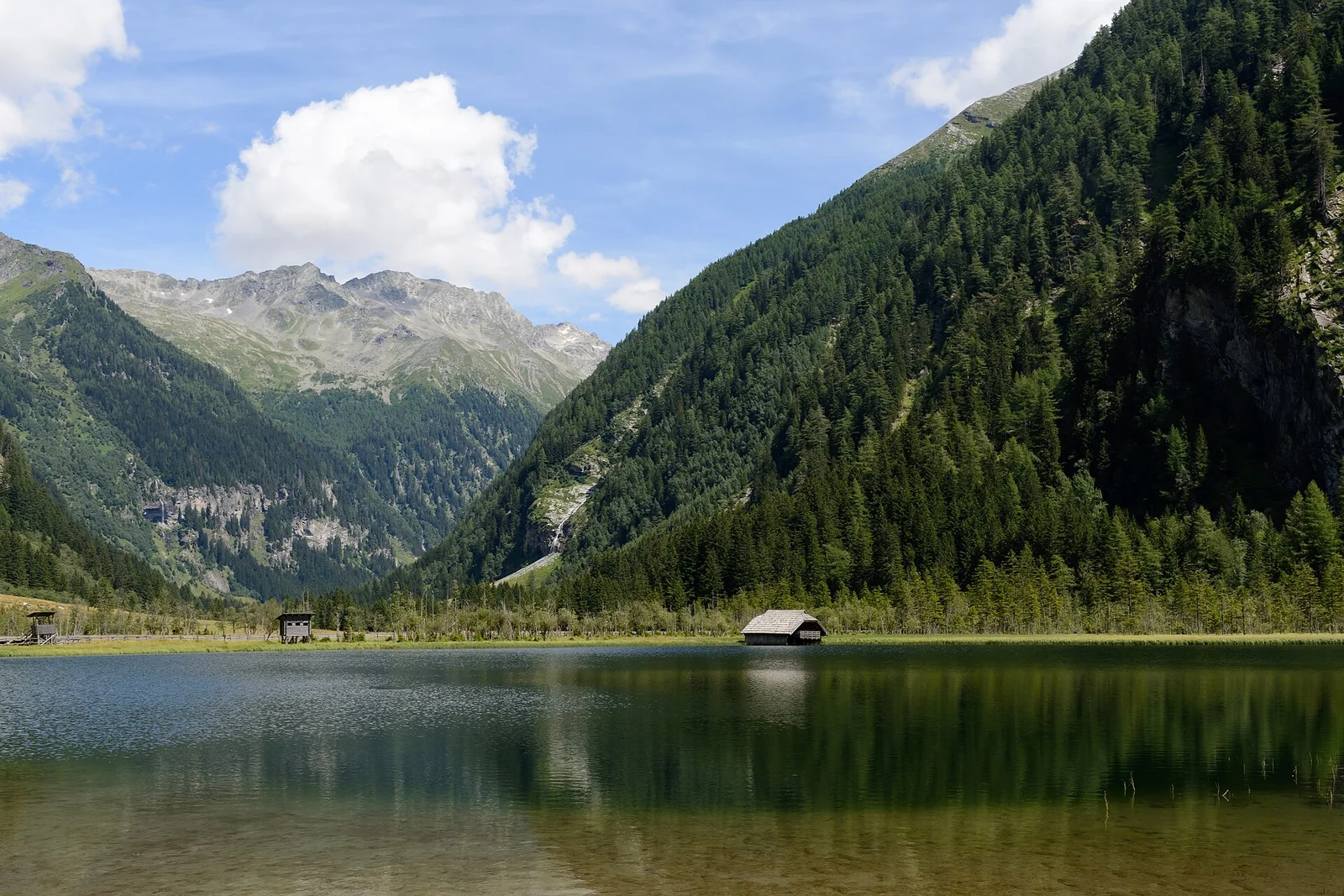
Choose the valley instead of another list of attractions
We recommend Seebachtal to people who want to stop moving between cities for a while and look at one mountain landscape. The visit is primarily about observing the water, slopes and forms of the valley, not about reaching the peak. It's a different kind of effort and attention than a long cycling stage.
The most rewarding thing is a separate day in Mallnitz, when you can combine the walk with the knowledge acquired in BIOS. Then the route has its own meaning and does not become an obligation added to the list of places "close to the trail". If you only have a short resupply after crossing the Tauern, it is better to keep the town itself and move on.
What exactly does the national park describe?
The official description of the trail starts at the Ankogelbahn car park, leads to Stappitzer See and continues through further educational stations. It is approximately 7 km and 2.5 hours for the loop. These are the parameters of this walking route, not the distance from Mallnitz station or the duration of the entire trip including the cycling stage.
Include in your plan how to get to the beginning and how to return. The educational trail is a pedestrian proposition; arrange bicycle access to its beginning separately. If you want to ride a bike to the starting point, check the current legal route and the conditions for leaving the bike.
Stappitzer See as an observation point
The lake is a clear starting point for exploring the valley, and the official description mentions signs and an observation platform. It is worth treating this fragment as a place of calm looking, not just a purpose for photography. Notice how water and the surrounding landforms influence the way people and animals use space.
You don't have to recognise all the species to get something out of your visit. You can start with simple comparisons: shaded and sunny places, standing and flowing water, exposed slopes and forested areas. This is an original observation proposal, independent of the seasonally available tour programme.
The path teaches you to read the terrain
The park describes sites dedicated to the formation of the valley, the course of the stream and characteristic phenomena, including cool air flow between rock blocks. For people used to seeing mountains only as a panorama, this is a chance to get down to the scale of detail.
During the walk, it is worth choosing one topic for the next few stops. If you are interested in water, observe its course and the various forms of the shore. If the terrain, compare the slope with the valley floor. This type of concentration does more than quickly reading all the boards without connecting them to what you see next to you.
Short version and full loop
The author's short version may be limited to the lake area and return the same way, if current access allows it. Select the scope of the short walk on the map from the place where you actually start. The full version is an official loop with adequate space for stopping at the stations.
If you choose a full programme, do not shorten it in your calculations to just the time of efficient walking. It is the stops that give the educational path its value. For a group travelling four days to the Adriatic, this means an extra day; for the five-day one it is also an extension, not a default part of the second stage.
The easy path is not a year-round guarantee
The verified park description indicates the season is from June to September. Other public materials may use the broader term spring-autumn, so you need to check the current condition of the path for a specific date. The municipal route card distinguishes between opening status and non-maintenance information; the word "open" itself should not be read as an endorsement of ideal conditions.
For the March date, a programme adapted to winter conditions is needed. Snow and seasonal access arrangements require a separate on-site assessment. If you want a nature programme independent of such a trip, check the current operation of BIOS and its exhibitions, instead of transferring the summer description of the path to winter conditions.
Mallnitz as a base without full panniers
An overnight stay in Mallnitz makes walking easier because you can leave your expedition equipment in an agreed location and only take the things you need for your hiking trip. Agree on the storage conditions with the facility, do not assume them based on the tourist character of the place itself.
When choosing accommodation, compare three directions: the station, the centre and the beginning of the trip. The address closest to one destination may not be the best for your entire stay. If you use a local bus, check the current timetable and return before leaving. When staying outside the main season, also make sure that the selected service is actually running.
The meal should not mark a risky return
For an additional day, plan your food according to your actual walking and transportation time. Don't make your entire trip dependent on opening one mountain restaurant that you haven't tested. The option of having a meal on your return to Mallnitz gives you more flexibility in the length of your stops at the lake and boards.
After such a day, further cycling to the Möll Valley can start the next morning. This is a solution for people who want to make a nature trip from Alpe Adria, and not just a quick trip. If you keep to a strict four or five days, consider Seebachtal as a well-described alternative for the future and choose a smooth continuation of the stage.
Sources and currency
- Hohe Tauern National Park — Seebachtal natural heritage ↗Checked: 2026-11-24
- Mallnitz Municipality - Current status of the path ↗Checked: 2026-11-24
- Austrian Ministry - Seebachtal Path ↗Checked: 2026-11-24
Organizational tips, selection of stops and scenarios are editorial suggestions. Times and budgets are not an offer or reservation. Check the opening of attractions, announcements and transport conditions for a specific date. Additional trips are not automatically part of the GPX.