A town at the transition between the Alps and Friuli
Gemona lies between Tagliamento and the Cuarnan and Cjampon mountains. Its historical importance was associated with the road between the Adriatic Sea and the Alps. For you, it's a similar moment of transition: mountain valleys give way to a more open landscape, but the city still leans heavily on the slopes.
It is worth separating the ride through the Gemona area from a visit to the historic centre. Check the cathedral's location relative to your GPX and choose the actual route. The length of the branch depends on where you leave the route and the chosen return. With a four-day plan, this is part of a long finale, so the additional climb should be a conscious choice.
Santa Maria Assunta: the facade as the main focus
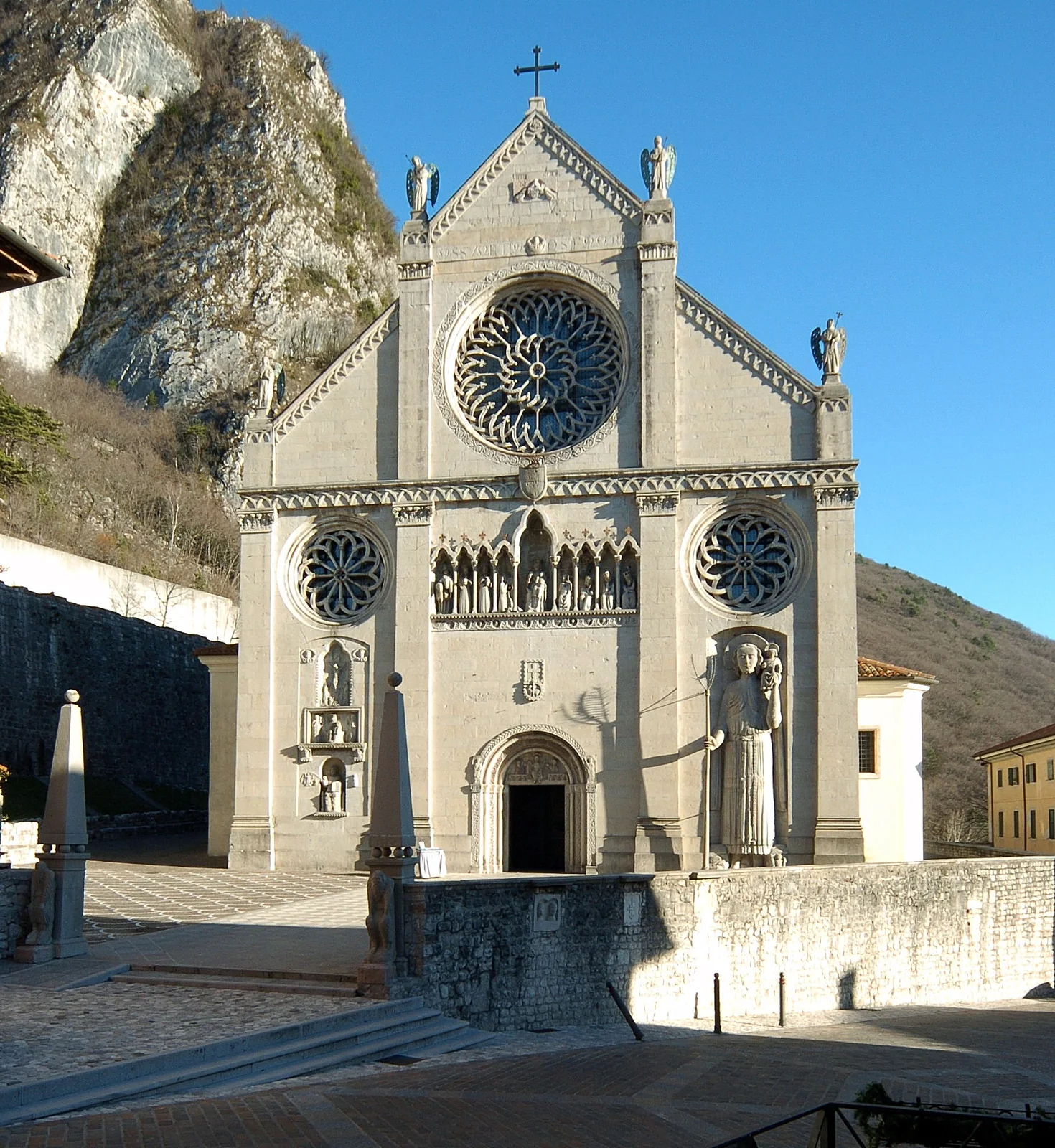
The Cathedral of Santa Maria Assunta combines Romanesque and Gothic forms. Italia.it highlights the central rose window, the gallery of Epiphany scenes, a large depiction of Saint Christopher and the Romanesque portal taken over from an earlier church. The facade itself provides material for a careful, short stop.
First, stand so as to see the whole thing, then approach the details. Compare the scale of Christopher's figure with the portal and rosette: different elements organize the view in different ways. You don't have to go into every facility to see something specific; with the interior closed, there is no reason to consider the visit a failure.
Via Bini: from the facade to the city
Opposite the cathedral, Via Bini begins, indicated by the national tourist portal as a narrow axis with houses retaining fragments of paintings. A walk along this street allows you to go from monumental architecture to the residential scale.
Look primarily for the relationship between the houses and the street: portals, fragments of decoration and the rhythm of the facades. Don't try to compare every detail with the illustration in the guide. This is a good place for slower viewing, where just riding a bike may be more comfortable than riding among pedestrians. The programme does not require entering private courtyards or looking into residents' windows.
Reconstruction as part of contemporary identity
The 1976 earthquake is central to Gemona's history. The regional website describes the city as a symbol of rebirth and the so-called Friulian model. A tour of Venzone allows you to see that the reconstruction of the region was not a single architectural project, but a set of decisions affecting many different places.
First of all, compare the scale and layout of the space. Venzone is easy to remember because of its walls and closed centre; Gemona has a different relationship with the terrain and surroundings. Don't reduce both to an identical story about a "rebuilt medieval town". Each shows a different dimension of the return of everyday life after the disaster.
Museo della Pieve and treasury
The parish museum and the cathedral treasury are located in the former canony. The official description also emphasizes the importance of the archive with very old baptism registers. This is an offer for people interested in the history of the local community and what was kept around an important church.
A museum visit is a separate choice, not an automatic extension of a brief look at the facade. Check availability and scope of exhibition. If your main topic is reconstruction, you don't necessarily have to see the vault; if you are interested in sacred art, a museum may be of greater value than another distant viewpoint.
Plan for 20, 60 and 120 minutes
The times below apply to your stay at the historic centre. Travel from Alpe Adria and return must be charged separately. Thanks to this, the choice remains fair for people who ride the stage mainly for the bicycle route.
| Time on the spot | Choice |
|---|---|
| 20 minutes | The facade of the cathedral and a short section of Via Bini. |
| 60 minutes | Cathedral, if available, and a walk along a historic street. |
| 120 minutes | A cathedral, a street and one museum or a longer walk; without adding mountain trails. |
Gemona as a junction for other routes
The region identifies Gemona as the meeting point of FVG1, FVG3 and FVG6 and an important railway junction. This may be useful for future expeditions, but does not mean that four bicycles will be freely available on every train. The timetable and rules must be checked for a specific connection.
Mountain destinations, Lake Minisini or further routes along Tagliamento do not automatically fit into a short stop. In the current plan, choose the cathedral and the city or stay on the main trail. Gemona works best as an informed extension of a programme whose cost and theme is understood by the entire group.
Sources and currency
- PromoTurismoFVG - Gemona del Friuli ↗Checked: 2026-11-24
- Italia.it - Gemona Cathedral ↗Checked: 2026-11-24
- Italia.it - Gemona and Via Bini ↗Checked: 2026-11-24
- PromoTurismoFVG - Museo della Pieve ↗Checked: 2026-11-24
Organizational tips, selection of stops and scenarios are editorial suggestions. Times and budgets are not an offer or reservation. Check the opening of attractions, announcements and transport conditions for a specific date. Additional trips are not automatically part of the GPX.