Alpe Adria meets the larger river route
The Drauradweg is an independent trail that goes much further than the part used during your trip. The official Spittal–Villach stage is approximately 39.8 km long. This figure describes a specific stage defined by the operator; commuting to accommodation and selected attractions may change your daily counter.
It is worth knowing this difference so as not to interpret every signpost on the Drava as a direction to Grado. In Villach your journey will diverge towards Tarvisio, while the river route continues. Consciously recognising the names makes navigation easier and allows you to see that Alpe Adria uses several existing communication corridors.
An agricultural valley instead of one big view
The official description leads through an agricultural landscape, small villages and sections on river embankments. It's worth changing the way you look: instead of expecting another gorge or a high waterfall, pay attention to the rhythm of fields, settlements and bridges. This part of the trip gives you a needed change of scale through the mountain valleys.
We suggest choosing one short scenic stop and one related to the town, instead of looking for attractions every few kilometres. Thanks to this, the episode remains fluid and does not become just a transfer. If it is raining or windy, the character of the section is assessed differently than in a sunny photo; a wide valley does not always mean easier conditions than the more sheltered part of the route.
Molzbichl and Museum Carantana
Museum Carantana is devoted to the early Middle Ages, the history of the church and monastery, and ancient customs related to life and death. This is a different range from the Roman Teurnia visited before Spittal. People interested in history can compare the changes in the region in subsequent eras from both places.
For a short trip, however, it is better to choose a museum whose topic interests you more than to treat it as a must-see. Carantana may be particularly interesting if you want to go beyond the classical monuments of the Roman Empire. Confirm the exact opening day with the museum: its website provides different sets of days of the week, and a winter break has been announced until May 2027.
Quarry as part of the panorama
The Drauradweg portal points to the visible Gummern marble quarry. This is a clear example that the Alpine landscape also includes the exploitation of raw materials. After the salt and ore museums, you can recognise another material that influenced the appearance of places and the economy of the region.
View it from accessible places along your route. Do not assume that you will be able to enter the plant or tour the area of active operations. It is worth comparing the clearly geometric traces of work with the slope around: it is a simple way to notice the difference between the natural shape of the mountain and the form created by humans.
Bridges and crossings are for orientation
On the river you will find various ways of connecting the banks. The regional portal also lists the Lansach–Feffernitz ferry as an attraction, but its presence in the catalogue does not mean that it is an essential or constantly operating element of your trail. Before making an additional crossing, you need to check the current rules and method of return.
For basic travel, the most important thing is to maintain the correct route on bridges and turnouts. When several routes run along the same river, the intuitive "I continue next to the water" may not be enough. An additional crossing to the other side may lead to an interesting place, but it should result from a specific goal and not a random choice of route.
Choose your pace according to the visible section
Don't judge the entire valley by one photo of the surface. The river route consists of sections with different functions and environments, and current works or diversions may change the route. Before leaving, check the operator's announcements and use the current signage on site.
In practice, it is best to maintain a pace that allows you to react freely to intersections, pedestrians and passages through towns. This is a good section for an even group ride, provided that the conditions on a specific section allow it. Trying to recapture every minute you previously spent in museums tends to spoil the most relaxing part of your trip.
Stop in the valley or in Villach
If you are going for four days, this part falls at the end of the day after crossing and passing the Mölltal. A short break can help you arrive in Villach with energy for dinner. If you are going for five days, you start from Spittal in the morning and you can plan a larger meal in Villach, before continuing towards the border.
The trail operator publishes the Drauradweg Wirte network, which includes accommodation, catering and services for cyclists. This is a starting point for your search, not a guarantee that the selected facility is open daily or has a vacancy. Check the actual location and opening hours of the kitchen, especially if you want to go outside the main season.
Villach is the end of a section, not the entire river axis
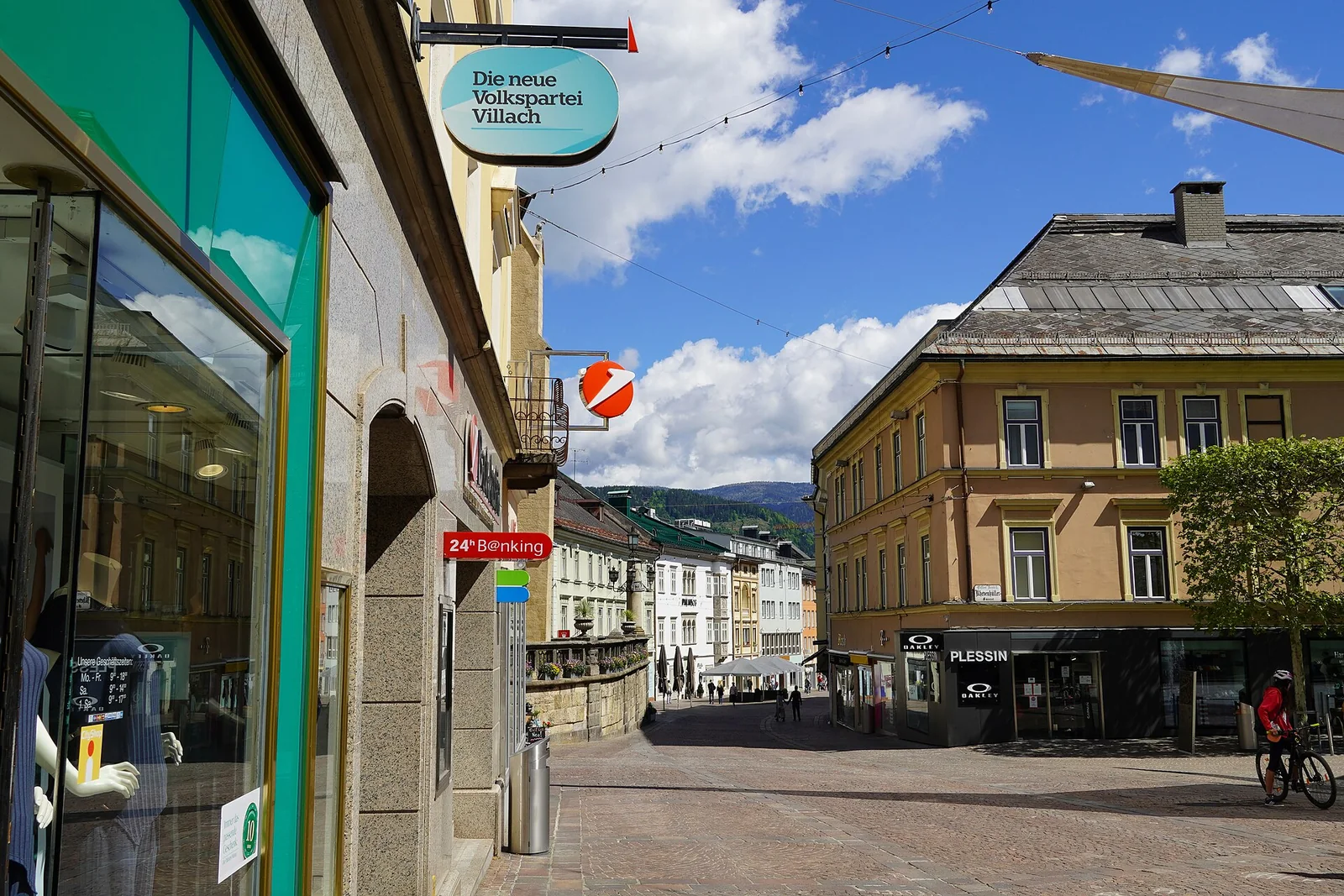
Entering Villach changes the setting from an agricultural valley to a city. In the four-day variant, first arrive at your accommodation and only then choose a walk around the Old Town. In a five-day tour, the city is a stop, after which the road to Tarvisio remains; tour times should reflect this.
Before leaving the city, check the further direction of Alpe Adria. The riverside course of the Drava tempts you to continue, but your route changes the axis. This is a good moment to compare the whole day with the map: from the quieter river section you go again towards the border and the higher Tarvisio. The mountain part of the trip did not end after Tauern.
Sources and currency
- Drauradweg - stages and services ↗Checked: 2026-11-24
- Drauradweg - Spittal–Villach ↗Checked: 2026-11-24
- Museum Carantana - exhibition and current information ↗Checked: 2026-11-24
Organizational tips, selection of stops and scenarios are editorial suggestions. Times and budgets are not an offer or reservation. Check the opening of attractions, announcements and transport conditions for a specific date. Additional trips are not automatically part of the GPX.